Across Seas and Hands: Craft, Movement and Memory
- minalnaomi
- May 25
- 6 min read
Recently I have begun to wonder about the lost notions of craft, moving beyond perceived borders. When I refer to borders, I speak of the ‘National Borders’. Those ubiquitous arbitrary lines drawn across maps somewhere in Europe, by a bunch of men who probably hadn’t ever been to the region, but recognised the geo-political necessity to draw these lines, in order to ensure that power remained within their control (rant over!).
Were artisans moving between regions within Asia, and are the craft objects we encounter today the result of sustained interaction across diverse communities? What were the lives and working conditions of these artisans, and do archival records reveal evidence of their workshops or networks? Finally, how do objects function as vessels of memory, carrying traces of the people and societies to which they once belonged?
I have so many questions I’ve wanted to explore, and this post does nothing to answer these questions -- but I hope this leaves you thinking about the shared craft inheritances that countries laud as ‘National Heritage’, bypassing the idea that we were all once connected.
This idea took shape during a visit to the Collectie Centrum Nederland in Amersfoort with fellow NUFFIC scholars from across the former Dutch colonies. I was immediately drawn to a large four-poster bed - its blackened ebony surface gleaming under the lights, its intricate carvings reminiscent of the liyavel (vine) motifs associated with the Kandyan kingdom of Sri Lanka. I first pointed this out to my fellow Lankan scholar, Dinusha Wepitiyage. With the help of our nifty and particularly bright scholar, Made Naranaya from Indonesia, we were able to locate the object’s description. I was surprised to learn that while the beds origins pointed to Batavia (modern day Jakarta), its craftsmanship was attributed to traditions from Ceylon and South India.


As someone who has spent years engaging with Lankan interiors with a special interest in traditional woodcarving traditions, this discovery was particularly compelling. Contemporary Lankans often look to Indonesia - especially Bali - as the apex of traditional craftsmanship, with little awareness that Lankan artisans once held comparable recognition. Decades of political instability, civil conflict, and rapid development have eroded many craft traditions. Yet this bed stands as material evidence of Lankan artisans travelling to Batavia and participating in trans-regional craft production.
In Salve in a Palanquin (Wickramasinghe, 2020), Wickramasinghe cautions against viewing history through rigid territorial boundaries, noting that “the history of enslaved people cannot be divorced from the histories of other places… [but is] inserted in a wider territorial and oceanic loop.” This perspective prompts further questions about the experiences of artisans from Ceylon and South India who reached Batavia, also known as the ambachtslieden who were trained by European masters called meersterknechten (Anthonisz, 1929). Were their movements between the winkels (workshops) voluntary or coerced? How were their skills deployed, adapted, or transformed within colonial systems of production?
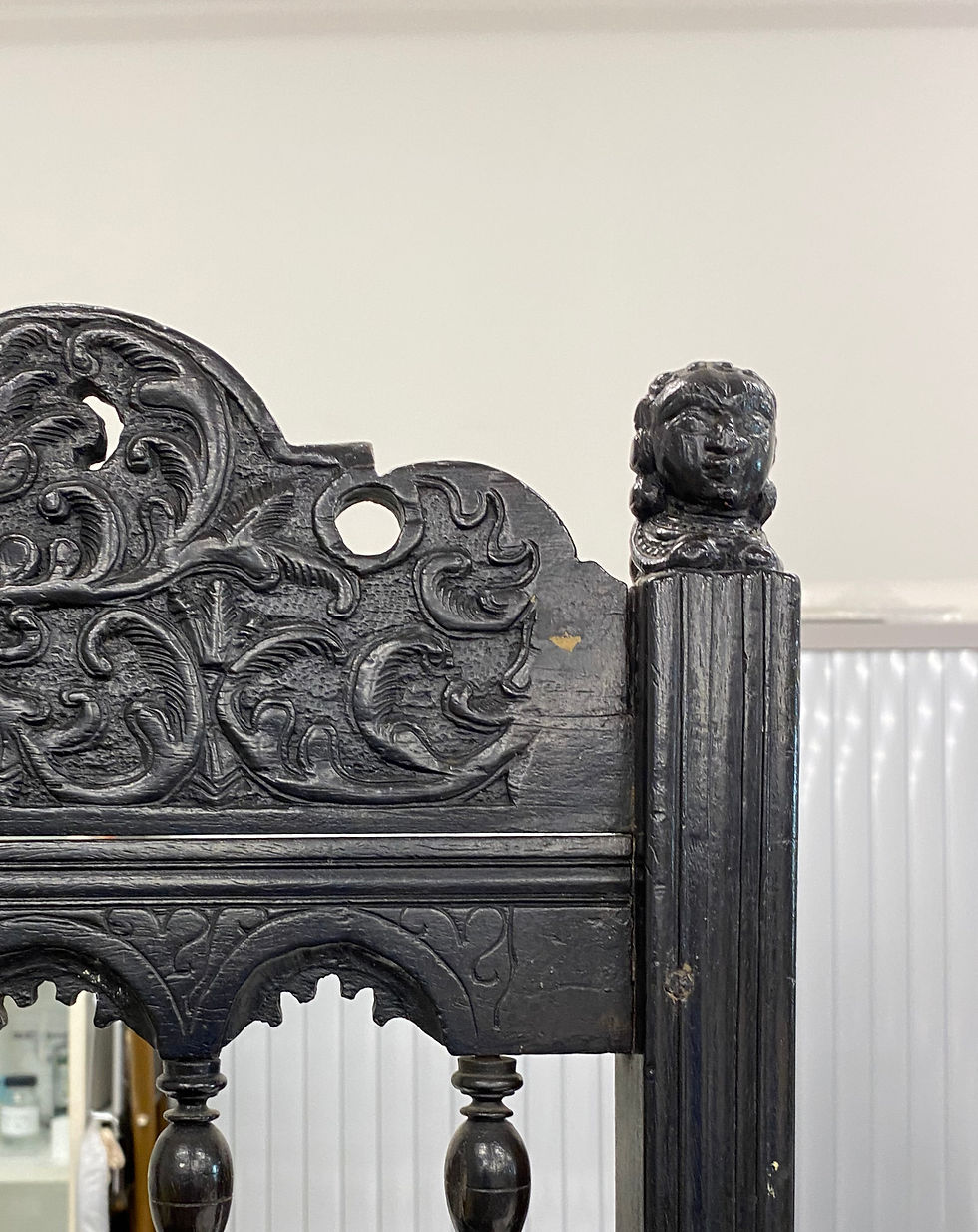
A similar line of inquiry emerged during a visit to the Wereldmuseum Leiden, where curator Priya Swamy facilitated access to Lanka-related objects. We were given the opportunity to pull certain items out of the depot for examination and my eyes darted straight to the chair amongst the list of objects in storage. I examined a chair featuring Indo-Portuguese style ebony carving, distinguished by a carved bust of a European man on the backrest, or “ear” of the chair. This detail suggests the object may have been produced either for export to Europe or for Dutch Burgher residents in Ceylon (Brohier, 1969). Such objects indicate that crafted artefacts - furniture, textiles, and decorative works - were significant trade items, alongside more frequently discussed commodities such as spices and agricultural goods. In his research Brohier also mentioned that certain Dutch folk would have these custom chairs in their homes and then every Sunday, carry their chairs to church for mass. I giggled at the thought of watching fancy lace-clad women in hats and gloves clutching onto their chairs (perhaps they had some local folk do this for them) whilst on their way to Sunday mass in the sweltering island heat.

This continuity of material use is also visible in Lanka today. While conducting research at Lanka’s National Library and Documentation Centre on Dutch-period colonial furniture, the collections manager, a smiley moustachioed man was eager to help. He was particularly intrigued at the fact that I wasn’t an architect, but was still busy getting photocopies of furniture. He then personally directed me to the administrative offices, assuring me that he had a surprise waiting. Here amidst the piles of books and sari-clad official looking aunties was a Dutch style chair in everyday use.

Made of ebony wood, the chair mimicked the form of a Baroque Dutch design but lacked ornate decoration, suggesting it may be a British-period reinterpretation of an earlier Dutch model. Notably, plastic castors had been added to allow the chair to swivel – an intervention that alters the original form while preserving its function. This adaptation illustrates how colonial-era furniture continues to be used in Lanka, with material heritage accommodating both historical continuity and contemporary practicality. I reflect on the sheer volume of objects that lie in depots in the Netherlands (and all around the European region) that are stored at the perfect temperature of 17 degrees Celsius at 40% humidity.
Whilst I understand the need for preserving objects, I wonder what happens to the use of the object. Chairs, tables, beds that were meant to be used, now lose their purpose and become ‘representational’ objects the moment they are ‘museumised’ (Appadurai, 1986).
Perhaps this is why I went home and bawled after visiting the Wereld Museum depot after witnessing the number of stone deities from Hindu Kovils and Buddhist monasteries from across my region. Deities that used to be bathed in milk and covered in turmeric, now codified and displayed with a tag on a shelf under ‘perfect conditions’. Although not religious myself, I am so accustomed to being around people who are. And whilst it might not have had a direct impact on me, I thought of the many thousands of people from my island and region who have been robbed of the opportunity to venerate these holy deities.
The VOC textile collection in Collectie Centrum further demonstrates the complexity of these exchanges. The textiles displayed visual elements derived from Indian block-printing techniques and batik traditions from the Malayan archipelago, while incorporating motifs intended for European consumers. These hybrid forms highlight the agency of Asian artisans who adapted their skills to suit foreign tastes. As an artist who has explored batik practices in Lanka at my friends workshop (Shout out to Saarah Dean Ismail, founder of Ira Industries who happens to have Malay roots herself), I am particularly interested in investigating how these designs emerged and what they reveal about artisanal decision-making within colonial trade systems. I equate this to the contemporary fashion industry that borrows from my region and then gives us no credit -- infuriating social media fashion girlies across Asia (It is not a Scandi-scarrrfffff she cries into the distance).
Professor Alicia Schrikker’s work provides essential historical context for these material
movements, noting that “the export products ranged from areca nuts and coconuts, to
cinnamon, gems, pearls and elephants. Imports included basic commodities like rice and textiles” (Schrikker, 2007). Such references underscore the circulation of textiles - and the labour and expertise behind them - within wider economic networks. Yet the artisans themselves remain largely absent from conventional trade histories.

I yearn to learn more about the artisan workshops. What were the working conditions like in these spaces? Were artisans from my island taken to Batavia and paid fairly? Were they treated like other craftsmen, or were they subjected to sweatshop-style working conditions similar to those found in the contemporary garment industry? I also wish to gain a better understanding of the formation of a heritage object. Did specialised craftsmen work on certain parts of an object before it was sent to another region for finishing? By situating objects within regional systems of trade, mobility, and cultural exchange, this approach foregrounds material culture as a carrier of memory across geographies and generations.
References
Anthonisz, R. G. (1929). The Dutch in Ceylon: An account of their early visits to the island, their conquests, and their rule over the maritime regions during a century and a half (Vol. 1). C. A. C. Press.
Appadurai, A. (Ed.). (1986). The social life of things: Commodities in cultural perspective. Cambridge University Press. https://doi.org/10.1017/CBO9780511819582
Brohier, R.L. (1969), Furniture of the Dutch Period in Ceylon, National Museum Board of
Ceylon.
Schrikker, A. (2007). Dutch and British colonial intervention in Sri Lanka, 1780–1815. Leiden
University Press. https://www.scribd.com
Wickramasinghe, N. (2020). Salve in a Palanquin, Colonial Servitude and Resistance in Sri
Lanka. Columbia University Press.
Please note all images are authors own and were taken for the purpose of research. Please do not re-use these images.

Comments